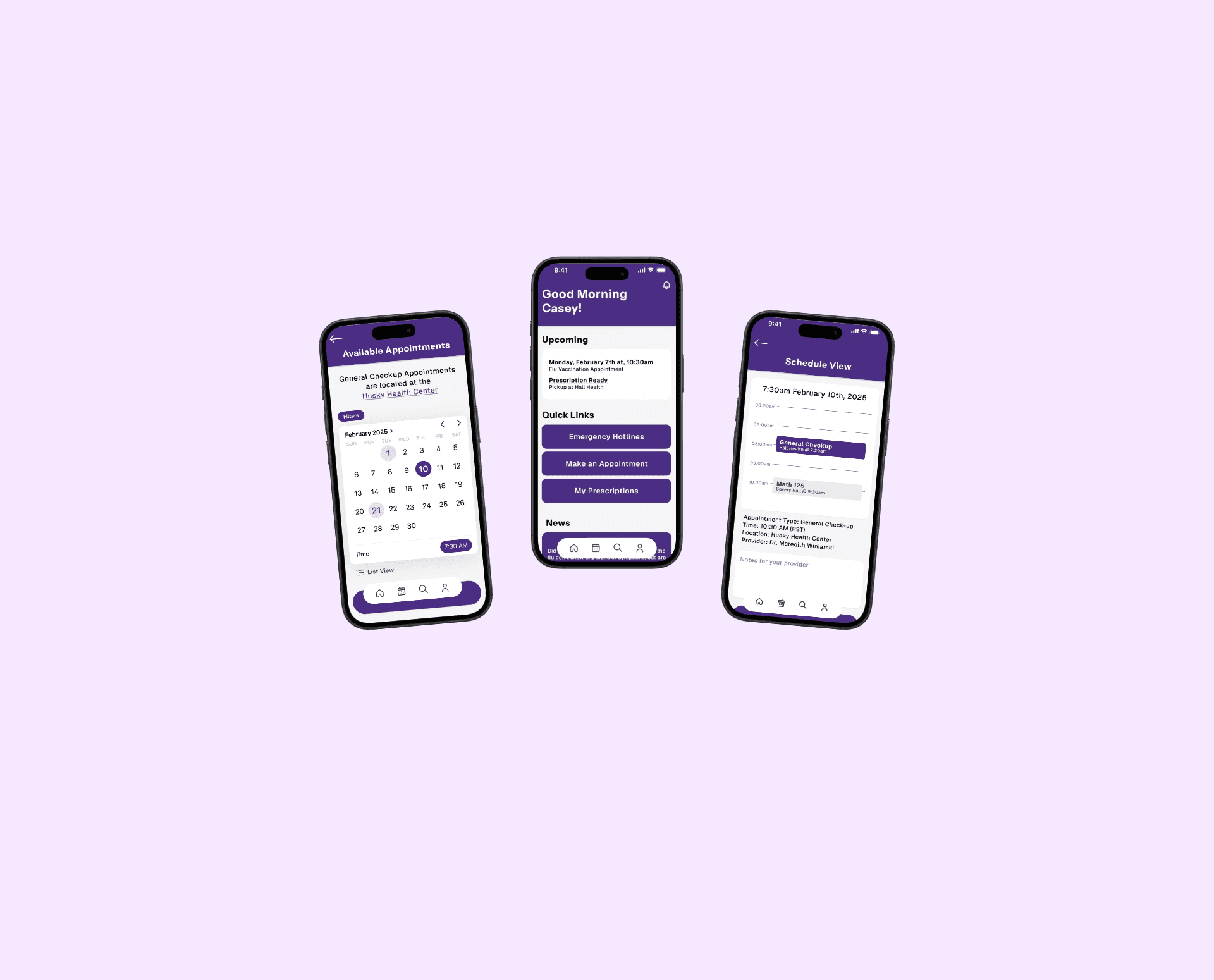
HUSKYCARE
Streamlining Student access to On-Campus Healthcare
Duration
Time: Sep 2024 - Mar 2025
Role
Product Design, User Research
Team
Meredith Winiarski (ME)
Jessica Forcucci
Athena Ortega
Context
This end-to-end team project was completed as part of a course focused on “Designing for Balance.” As current students, we reflected on how our peers most often struggled to maintain that balance and identified a common theme: health was frequently deprioritized in favor of academic demands.
Problem
Health is on the Backburner
Students recognize that accessing healthcare can be difficult while balancing school, work, and other responsibilities. How might we design a system that helps UW students seamlessly manage their healthcare needs during the busy academic year?
Solution
A UW-specific all-in-one mobile app that emphasizes convenience and empowers students to easily schedule appointments at on-campus healthcare facilities and access care quickly.
Jump to Solution
Competitive Analysis
Understanding the Market
We began with a competitive analysis to understand what solutions already existed to help users manage their healthcare and where they fell short of meeting the needs of UW students.


Valuable for first-time or returning users
Manage different aspects of healthcare
Products aren’t connected to on-campus healthcare
Multiple apps to manage recurring needs
Provide simple booking process
User Research
Interviewing 3 with various healthcare needs
To better understand students’ experiences, we conducted semi-structured interviews allowed us to explore key themes and ask follow-up questions to deepen our insights. Our findings revealed consistent pain points, along with several unexpected patterns that further shaped our design direction.
Time Constraints
"It's totally stressful. I need to make sure I schedule with enough time to travel to them and I'm not late. But also schedule in a time where it's not too inconvenient for homework and getting stuff done outside of the doctor."
Travel Time
"The place I got to is in Ballard, so its like a 30 minutes bus ride there and back…It's kind of stressful, like I know its gonna take at least two hours out of my day."
Scheduling
"It's annoying because its sometimes a long wait. I only have 20 minutes to call and half of it's on hold."
Vaccine Side Effects
“Sometimes I don't get my vaccines because they make me sick sometimes; I got sick from flu shots and COVID shots previously.”
Unexpected Costs
"Yeah, I could have basically been going somewhere else for a lot cheaper than the two years out of that Hall Health, which sucked. Yeah, I think also I didn't realize it.
Long Pickup Lines
"I went two times in the same week, and one time I was waiting for what felt like 30 monites, at leat 20. and the other I waited like 15."
Ideation
Understanding Constraints
Based on our research findings, students face many challenges when accessing healthcare, even when they aren't in school. Given the time constraints and required deliverables for this project, we recognized that there were many pain points that stemmed from systemic issues, which would require a major overhaul of the U.S. healthcare system.
Instead, we shifted out focus to what we could meaningfully impact: the experiences of UW students.
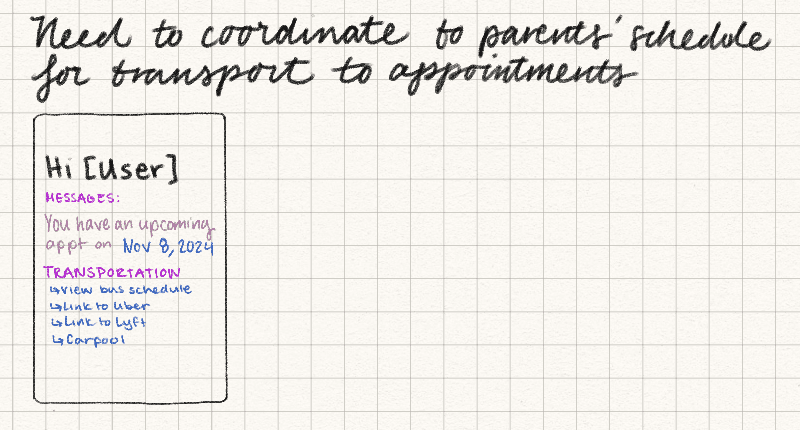
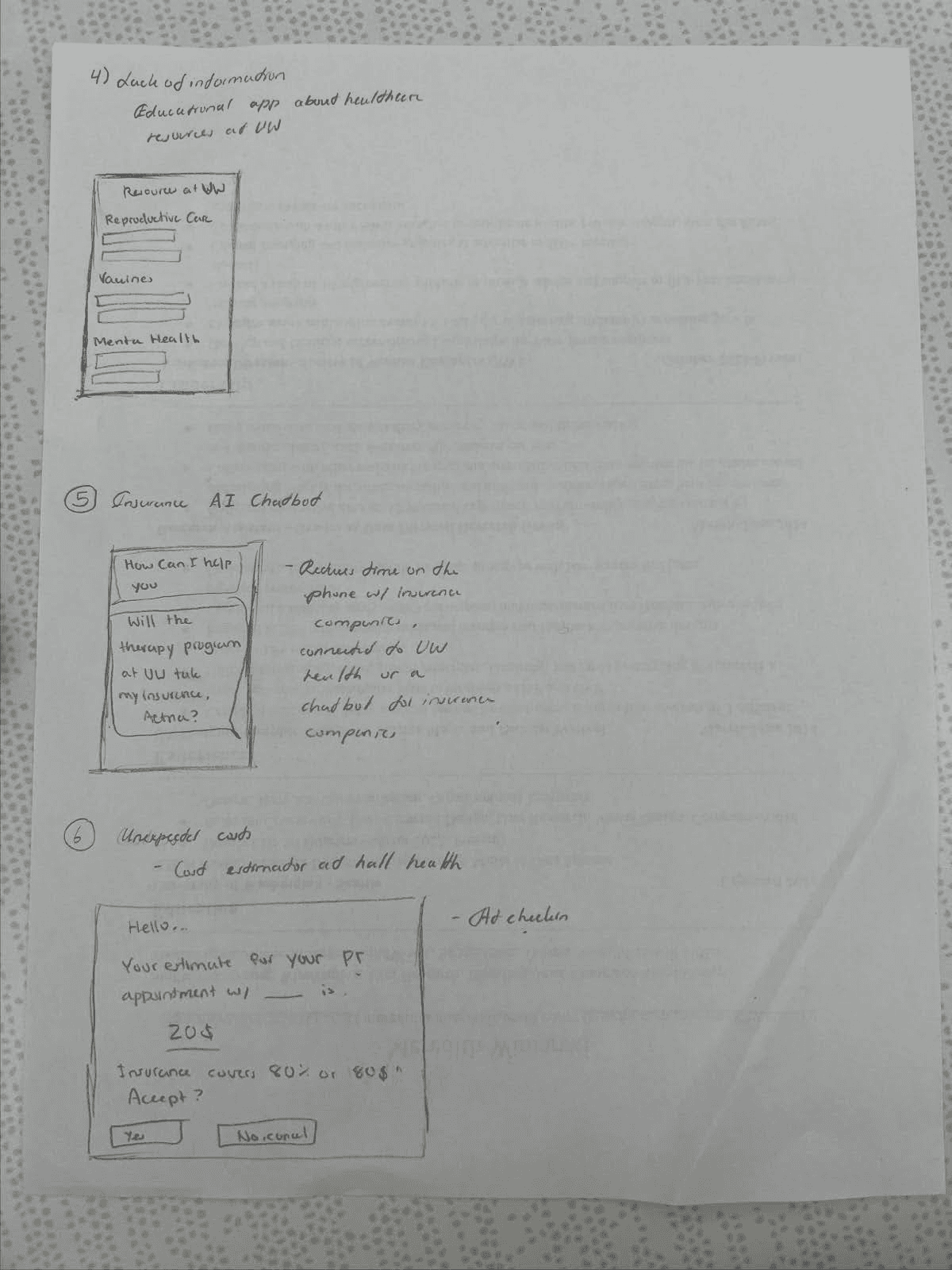
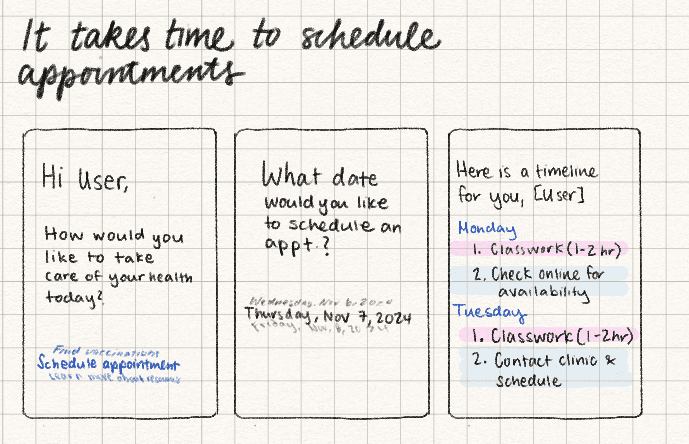
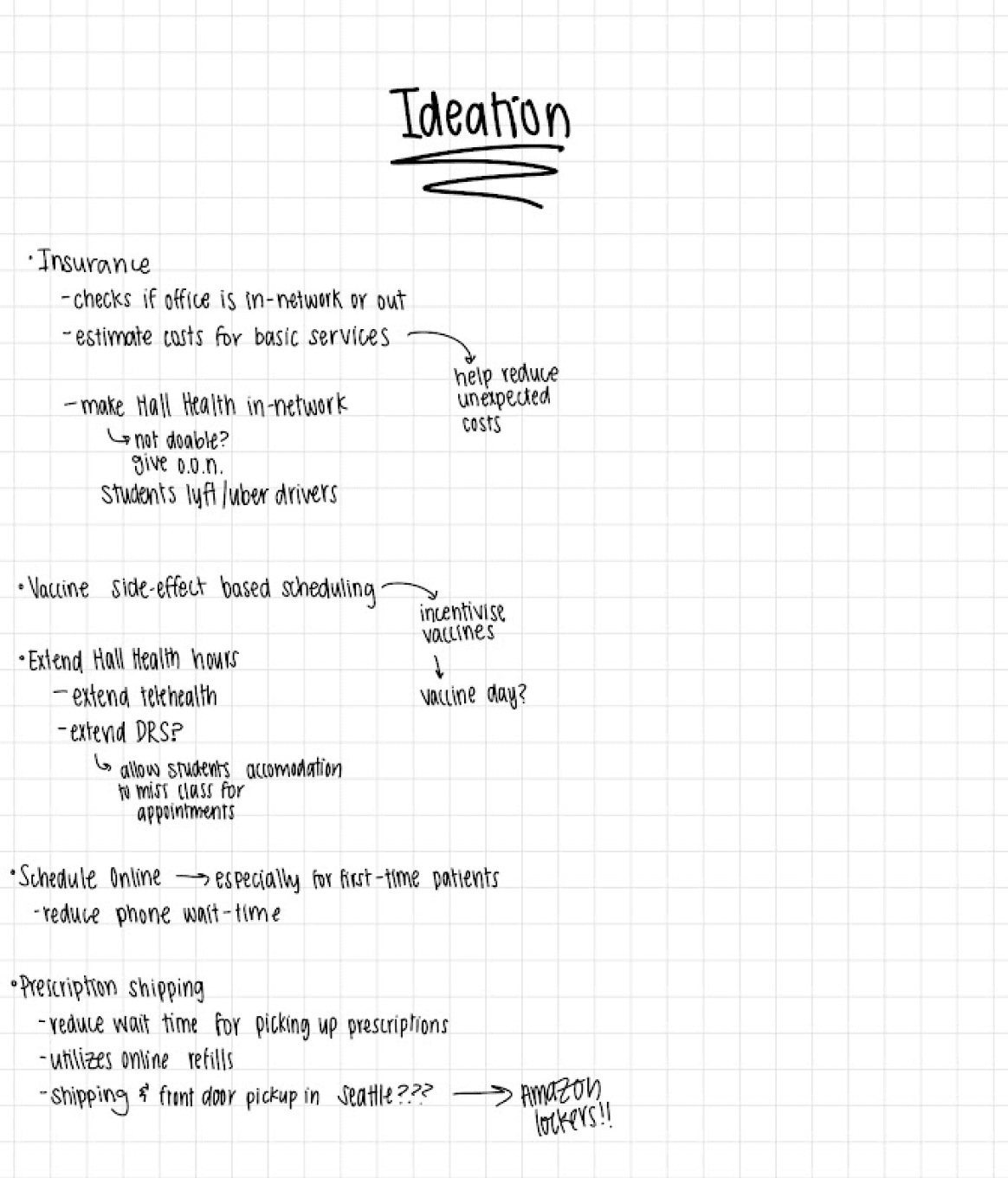
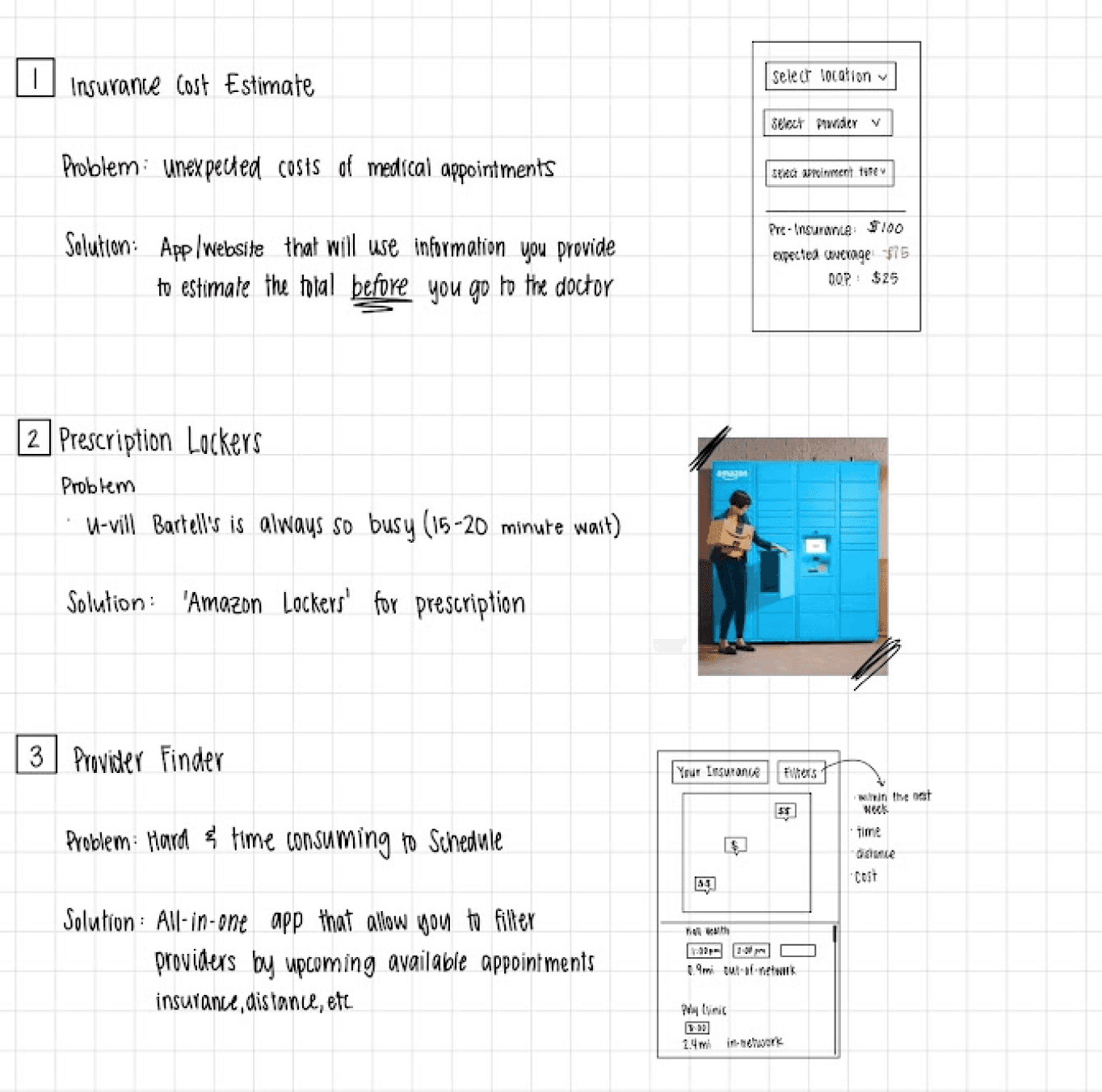
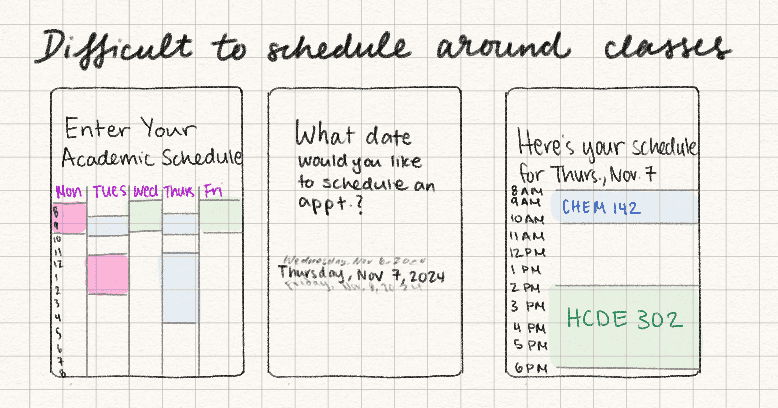
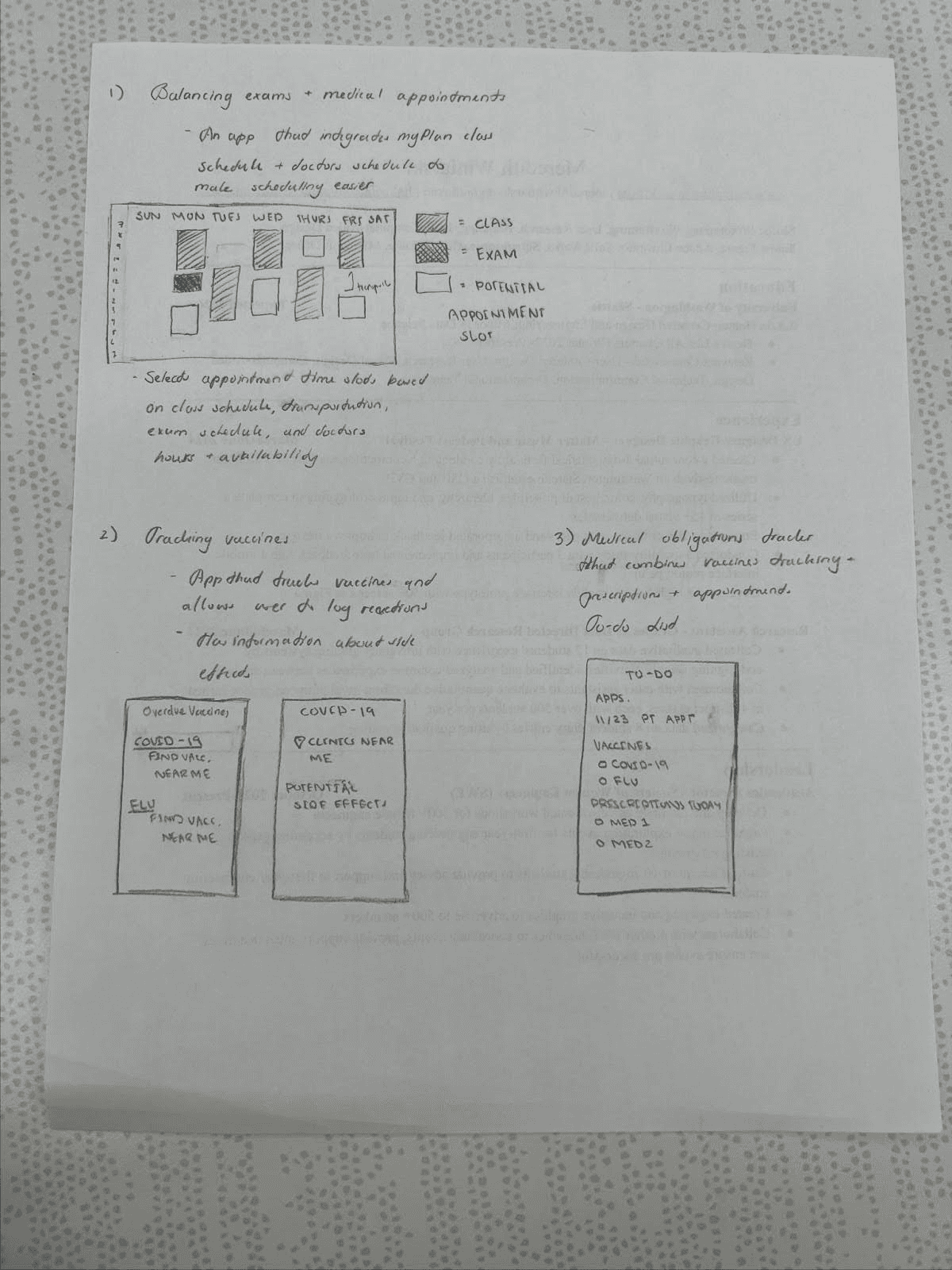
Brainstorming Sketches
Multiple Pain Points -> One Solution
Students identified many pain points when accessing healthcare during the school year. While there were several directions we wanted to pursue, we focused on a solution that addressed multiple pain points to have a measurable impact on the greatest number of students. Improving access to Husky Health Center services would reduce travel time and connect students with the closest healthcare provider.
Contactless Scheduling
Prescription Pickup
Vaccine Information
Insurance Information
Quick Scheduling
Decreased Travel Time
->
HuskyCare Mobile
Design Decisions + Prototypes
Do students need another app?
Working within the healthcare space, user privacy was a key consideration. During concept testing, users strongly preferred a mobile app, citing a stronger sense of security. This insight directly shaped our product direction.
Due to the time constraints of this project, we focused primarily on improving the students' experiences, meaning this insight directly shaped our product direction. With more time, I would have done additional research on the security of apps and both HIPPA and FERPA guidelines to ensure that our product was following UW student data privacy requirements.
Limited Time -> Major Imapct
Due to the time constraints and specified deliverables for this project, we focused on designing key features with user experience at the front:
Avoid Information Overload
Home Page
Provide upcoming appointments at a glance
Quick links for key services: prescriptions, scheduling, and emergency services
->

Fit Appointments into the User's Schedule
Integrated Calendars
Shows appointment availability with respect to the user's schedule
Provide a visual showing exactly how an appointment would fit in the user's schedule
->

No Second-Guessing
Preventing user error and limiting frustration
Confirmation overlays to confirm scheduled appointments
Warning pop-ups to confirm and ensure users are confident in their decisions
->
Reflection
Scoping Earlier + Expanding User Base
This project was my first end-to-end design experience, where our team selected the problem space and led every stage of the process—from research to final solution. It was a valuable introduction to balancing discovery, scoping, and execution.
One key takeaway was the importance of defining a focused design direction early. Our interviews revealed a wide range of challenges, and we initially struggled to narrow the scope to one core problem. Identifying that primary problem sooner would have enabled more targeted user testing, faster iteration, and a more refined final solution.
While our work centered on the student-facing experience, a future iteration would also account for medical professionals, receptionists, and other healthcare staff interacting with the system. Designing for all stakeholders would strengthen feasibility, usability, and long-term implementation success.
One key takeaway was the importance of defining a focused design direction early. Our interviews revealed a wide range of challenges, and we initially struggled to narrow the scope to one core problem. Identifying that primary problem sooner would have enabled more targeted user testing, faster iteration, and a more refined final solution.
While our work centered on the student-facing experience, a future iteration would also account for medical professionals, receptionists, and other healthcare staff interacting with the system. Designing for all stakeholders would strengthen feasibility, usability, and long-term implementation success.